What is MSRP? What the sticker price includes and leaves out
MSRP is a carmaker's suggested price for a new car. Read each line of the US window sticker, see what it leaves out, and learn what other countries call it.
Researched with AI assistance and checked against the sources below.
MSRP stands for manufacturer’s suggested retail price. It is the price a carmaker suggests a dealer charge for a new car. In the US, federal law requires it on a label in the car’s window. It is a starting point, not the amount you pay: sales tax, registration and dealer charges come on top, and a dealer can ask for more or less.
This article explains the terms. It does not tell you what to pay for a car.
What the window sticker shows
In the US, the Automobile Information Disclosure Act requires a carmaker to fix a label to the windshield or a side window of each new car before the car reaches the dealer.1 It is often called the Monroney label or Monroney sticker. Federal law requires it on the car until the first retail sale.23
The price part of the label has four lines, set by the statute:1
- The manufacturer’s suggested retail price of the car.
- The suggested price of each option or accessory fitted at delivery that is not in line 1.
- The charge to the dealer for transporting the car, also called freight or the destination charge.2
- The total of lines 1 to 3.
The same label also names the make, model, vehicle identification number, final assembly point and receiving dealer. It shows the government crash-test star ratings where they exist,1 and the fuel economy estimates.24
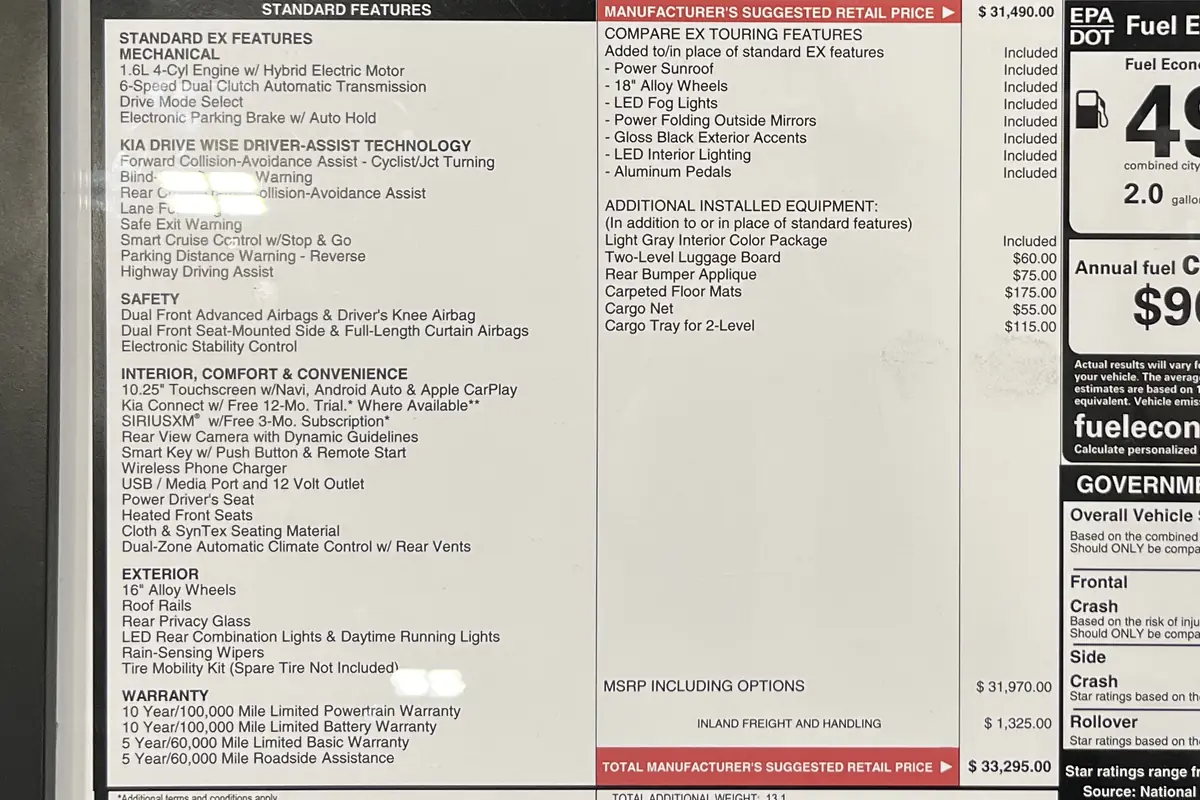
Fig. 1 A 2023 US window sticker: car price, options, freight and total MSRP. Photo: Corqe, Wikimedia Commons (opens in a new tab), CC0 1.0 (opens in a new tab), cropped to 3:2 and resized.
The label in the photo, from the Denver Auto Show in April 2023, uses the term three times. The top line, “Manufacturer’s suggested retail price”, is $31,490 for the car alone. Five priced extras bring “MSRP including options” to $31,970. “Inland freight and handling”, the destination charge, adds $1,325. The bottom line, “Total manufacturer’s suggested retail price”, is $33,295. When an ad quotes “MSRP”, check which number it means.
Fig. 2 Label total, worked example (not a real car) Source: worked example; line items per 15 U.S.C. 1232(f).1
MSRP, base, invoice and sticker price
Four price terms come up when you shop for a new car. A US state regulator, the Texas Department of Motor Vehicles, defines them in its new-car buying guide:2
| Term | What it means | Set by |
|---|---|---|
| Base price | The car without options, with its standard equipment and factory warranty | Carmaker |
| Sticker price (MSRP total) | Base price plus factory-fitted options plus the transport charge | Carmaker |
| Invoice price | The carmaker’s first charge to the dealer, usually including freight | Carmaker |
| Dealer sticker price | The sticker price plus items the dealer adds, such as extra markup or dealer preparation | Dealer |
Definitions from the Texas DMV guide, September 2019. Other guides may use the words differently.
The invoice price is not the dealer’s final cost. The same guide says a dealer can pay less, because it receives rebates, allowances, discounts and incentive awards from the carmaker.2
What MSRP leaves out
The label total covers only the car, its factory options and its transport charge.1 It has no line for:
- Taxes. Sales tax, or the equivalent where you live.
- Registration and title. The government fees to put the car on the road in your name.
- Dealer fees. Charges such as administration fees.5
- Dealer add-ons. In a 2024 case against an Arizona dealer group, the US Federal Trade Commission (FTC) said the group slipped in add-ons that buyers did not want or agree to, such as theft protection, paint coating, nitrogen tires and tinted windows.6
The FTC also warns that advertised car prices might not include various fees. It says the “out-the-door” price should include all charges and fees, and it suggests asking the dealer for that price in writing.7
Do cars sell at MSRP?
MSRP is a suggestion. The Texas DMV guide treats the final price as a matter for buyer and dealer, and it lists “additional dealer markup” as one item a dealer sticker can add.2 The Ontario Motor Vehicle Industry Council (OMVIC), the province’s dealer regulator, calls MSRP “a guideline, not a fixed amount”. It says the actual price often varies from dealer to dealer with fees, discounts and promotions.5
In the US in September 2026, the average MSRP of a new vehicle was $52,342. The average transaction price, Kelley Blue Book’s estimate of what buyers paid, was $50,562.8 Kelley Blue Book’s average transaction prices do not include applied consumer incentives.9
Fig. 3 US, Sept 2026: average MSRP vs average price paid Source: Cox Automotive, Kelley Blue Book, Oct 2026.8
An average across every model says little about one car at one dealer.
Buying “at MSRP” usually means paying the total on the label: no dealer markup and no discount. Taxes, registration and any dealer fees still come on top of it.
What other markets call it
In the US and Canada, the usual term is MSRP.25 Other markets use other words, and the rules on advertised prices differ.
- Canada. In Ontario, OMVIC requires a dealer’s advertised price to include all fees the dealer intends to charge, such as freight and pre-delivery inspection (PDI). Only HST and licensing may be added on top. The rule does not cover manufacturers’ own ads.5 Nationally, the Competition Act makes it illegal to promote a price that fixed mandatory fees make unattainable. Fixed charges that a government imposes, such as sales tax, are the exception.10
- United Kingdom. For vehicle tax, the government uses “list price”: the published price of a vehicle before its first registration and before any discounts.11 Under the Digital Markets, Competition and Consumers Act 2024, a total price should normally include any mandatory charges, and hiding them until later is illegal.12
- Australia. A business must show a total price as a single figure, including taxes, duties and unavoidable fees.13 For a car, that total is usually the “drive away” price on the windshield, according to Victoria’s consumer regulator.14
Where to report a misleading price
In the US, you can report misleading ads or hidden fees to the FTC at ReportFraud.ftc.gov.6 In Canada, the Competition Bureau takes complaints about drip pricing.10 In Australia, you can report misleading price displays to the ACCC.13
If you are buying a used car instead, do not expect a Monroney label: the law requires it only until the first retail sale.23 A dealer’s used car carries a different window form, the FTC Buyers Guide.15
Sources
- 1US Code, 15 U.S.C. 1232, label and entry requirements (Automobile Information Disclosure Act) (opens in a new tab). Accessed .
- 2Texas Department of Motor Vehicles, Smart Buyer: tips for buying a new car, September 2019 (opens in a new tab). Accessed .
- 3US Code, 15 U.S.C. 1233, violations and penalties (Automobile Information Disclosure Act) (opens in a new tab). Accessed .
- 4US Code, 49 U.S.C. 32908, fuel economy information (opens in a new tab). Accessed .
- 5Ontario Motor Vehicle Industry Council (OMVIC), Understanding the difference between MSRP and all-in price advertising, 10 December 2025 (opens in a new tab). Accessed .
- 6US Federal Trade Commission, Did you ask for all those add-ons? Protect yourself at the dealership, 15 August 2024 (opens in a new tab). Accessed .
- 7US Federal Trade Commission, Car dealer ads and promotions: know before you go (opens in a new tab). Accessed .
- 8Cox Automotive, September 2026 Kelley Blue Book average transaction price report, 13 October 2026 (opens in a new tab). Accessed .
- 9Cox Automotive, September 2026 Kelley Blue Book average transaction price tables (opens in a new tab). Accessed .
- 10Competition Bureau Canada, Drip pricing (opens in a new tab). Accessed .
- 11GOV.UK, Vehicle tax rates: cars registered on or after 1 April 2017 (opens in a new tab). Accessed .
- 12Competition and Markets Authority, Providing clear and accurate information about prices: summary (CMA209) (opens in a new tab). Accessed .
- 13Australian Competition and Consumer Commission (ACCC), Price displays (opens in a new tab). Accessed .
- 14Consumer Affairs Victoria, ‘Cash price’ and ‘drive away price’ (opens in a new tab). Accessed .
- 15Electronic Code of Federal Regulations (via LII), 16 CFR 455.2, consumer sales: window form (opens in a new tab). Accessed .