What is a plug-in hybrid (PHEV)?
A plug-in hybrid (PHEV) has a battery you charge from an outlet and a gas engine for longer trips. See how it works, how to read its label and why charging matters.
Researched with AI assistance and checked against the sources below.

A plug-in hybrid, or PHEV (plug-in hybrid electric vehicle), is a hybrid with a high-capacity battery that you charge by plugging it into an outlet or a charging station.1 The battery covers short trips on electricity, and a gasoline engine takes over for the rest.
For how any hybrid works, see our guide to hybrid cars.
How a plug-in hybrid works
A PHEV has an engine, an electric motor and a battery pack, generally larger than a regular hybrid’s. As of 2026-10-18, the US Department of Energy puts the electric range of current models at about 15 to 60-plus miles.2 The battery charges from charging equipment, from the engine and from regenerative braking.2
In town, most of the power can come from the battery. A driver with a short commute can drive to work and back on electricity, plug in overnight and do it again the next day. The engine runs when the battery is mostly empty, under hard acceleration, or when heating or air conditioning needs a lot of power.2
Plug-in hybrids come in two basic layouts:1
- Series, or extended-range electric vehicles (EREVs). Only the motor turns the wheels. The engine just makes electricity once the battery runs down.
- Parallel, or blended. The engine and the motor both drive the wheels. Electric-only driving usually happens only at low speeds.
Can you put gas in a plug-in hybrid?
Yes. You can run it on gasoline alone and never plug it in, but it will not reach its best range or fuel economy.1 The Department of Energy says a PHEV that is never charged gets about the same fuel economy as a similarly sized hybrid.2
EPA ratings for two 2026 Kia models show this. With the battery run down, each plug-in hybrid is rated within 1 mpg of the regular hybrid with the same name and drive. The Niro FE trim is rated higher, at 53 mpg.3
Fig. 1 EPA gas-only mpg, 2026 Kia hybrids and plug-ins Source: fueleconomy.gov, as of 2026-10-18.3
So against a regular hybrid, a plug-in hybrid’s fuel savings come from plugging it in.
Plug-in hybrid vs hybrid: the differences
A regular hybrid cannot plug in. It charges its battery only from the engine and from regenerative braking.4 A full hybrid can drive on electricity alone, but only for short distances and at low speeds.4 A plug-in hybrid fills its battery from the grid and may cover a daily commute on electricity.2
Which is better depends on your driving. If you charge between trips that are shorter than the electric range, a PHEV may run on electricity alone; regular charging is the best way to get its benefits.2 If you cannot charge, it gives you about what a hybrid does.
How to read the EPA label on a plug-in hybrid
In the US, the window sticker for a plug-in hybrid shows two fuel economy figures, both for combined city and highway driving.5
- Left box: MPGe on electricity. Miles per gallon of gasoline-equivalent, plus kilowatt-hours per 100 miles.
- Right box: MPG on gasoline, once the battery is empty.
- Driving range: the approximate miles on a full charge before the car needs recharging.5 Federal rules add a total range: the distance on a full tank and a full battery.6
- Charge time: the hours to charge an empty battery at 240 volts.
The fueleconomy.gov listing for a blended plug-in hybrid gives two electric ranges, for example “33 miles Elec + Gas” and “All Elec: 0-33 mi”.7 Federal labeling rules explain the second figure. For a car that uses the battery and the engine together before the battery is empty, the all-electric range is the distance it drives before the engine starts, and it may be shown as a range of values.6 So the engine can start anywhere between zero and the full electric range, depending on how you drive.7
| Model | Range on a full charge | All-electric | On electricity | On gas only | Charge time at 240 V |
|---|---|---|---|---|---|
| Kia Niro Plug-in Hybrid | 33 mi | 0–33 mi | 108 MPGe (31 kWh/100 mi) | 48 mpg | 2.8 h |
| Ford Escape FWD PHEV | 37 mi | 0–37 mi | 101 MPGe (33 kWh/100 mi) | 40 mpg | 3.2 h |
| Mitsubishi Outlander PHEV | 44 mi | 0–45 mi | 73 MPGe (47 kWh/100 mi) | 27 mpg | 6.5 h |
fueleconomy.gov ratings as of 2026-10-18. The range on a full charge is the “Elec + Gas” figure. The Outlander’s 44 mi and 0–45 mi are as the EPA publishes them.7
Real-world use versus the official figures
The label warns that how you drive, air conditioning, the weather, the road and the load can change your results.5 Three effects are worth knowing:
- Speed and acceleration. In a blended PHEV, electric-only driving usually happens only at low speeds.1 Rapid acceleration brings in the engine.2
- Cold and heat. Heavy heating or air conditioning loads also bring the engine in.2 To keep more of the battery for driving in winter, preheat the cabin while the car is plugged in, and use the seat heaters instead of the cabin heater.8
- How often you charge. The European data below shows the cost of skipping it.
What European on-board data shows
Since January 2021, new EU cars that can run on liquid fuels must carry an on-board monitor that records fuel and energy use and distance. Manufacturers report the data to the European Commission.9
The Commission’s July 2024 publication compared that data with the official WLTP (Worldwide Harmonised Light Vehicle Test Procedure) values. For plug-in hybrids first registered in 2021, real-world CO2 emissions were on average 3.5 times the official values. For 2022 registrations the gap held steady in absolute terms, from 99 to 102 g/km, but grew from 249% to 314% in relative terms.9
Fig. 2 Real-world CO2 above WLTP, EU cars first registered 2021-22 Source: European Commission, July 2024.9
The Commission’s explanation: largely, owners do not charge these cars and drive them on electricity as often as expected. The 2022 models had larger batteries, which lowered their official values, but the data suggests the share of electric driving has not risen.9 The Commission has changed the “utility factor”, the share of electric driving the official test assumes.9 The first step applies to new models approved from 1 January 2025 and to all new cars from 2026. A second step is scheduled, as of 2026-10-18, for new models from 1 January 2027 and all new cars from 2028.10 As of 2026-10-18, the European Environment Agency’s yearly data covers cars first registered from 2021 to 2024.11
How long does a plug-in hybrid take to charge?
In the US, most drivers of plug-in vehicles charge overnight at home, on Level 1 or Level 2 equipment.12 The Department of Energy and the EPA give these typical times for a plug-in hybrid:1
- 120-volt household outlet (Level 1): several hours. The Department of Energy estimates that Level 1 adds about 5 miles of range per hour, at 1.9 kW.13
- 240-volt home or public charger (Level 2): about 1 to 4 hours. Some models take longer: the Outlander in the table above is rated at 6.5 hours.7
- Fast charge: to 80% in as little as 30 minutes.
Whether your model accepts DC fast charging is in the owner’s manual or spec sheet. Our guide to charging speeds compares the levels.
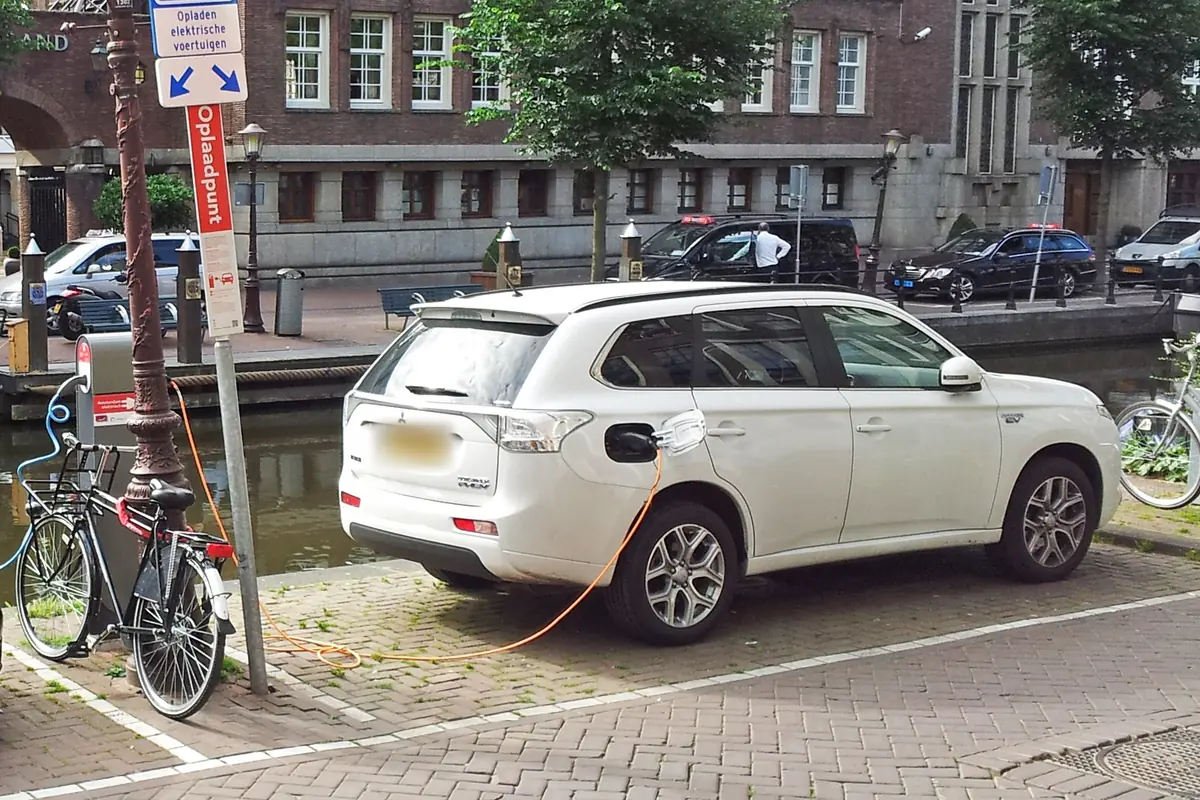
Fig. 3 Outlander PHEV charging in Amsterdam, 2014. Photo: AxelBoldt and Mariordo, Wikimedia Commons (opens in a new tab), CC0 1.0 (opens in a new tab), plate blurred and resized.
What are the downsides of a plug-in hybrid?
- Price. PHEVs generally cost more than similar conventional cars and hybrids.2 Whether fuel savings make up the difference depends on the car, your share of electric miles, fuel prices and how long you keep it.1
- Charging takes time. A recharge takes hours on a home outlet or a Level 2 charger.1
- Two drive systems. A PHEV has an engine, so it needs the same general maintenance as a conventional car. The battery, motor and electronics need little scheduled maintenance, and the brakes usually last longer thanks to regenerative braking.14
A PHEV has a high-voltage electrical system of several hundred volts. Its high-voltage cables, inside the car, are usually orange.14 Never touch or repair these cables, the battery pack or any other high-voltage part yourself. Like brakes, steering, airbags and fuel systems, EV high-voltage systems are work for a qualified technician.
Sources
- 1US Department of Energy and EPA, Plug-in hybrids (opens in a new tab). Accessed .
- 2US Department of Energy, Alternative Fuels Data Center, Plug-in hybrid electric vehicles (opens in a new tab). Accessed .
- 3US Department of Energy and EPA, fueleconomy.gov side-by-side ratings for the 2026 Kia Niro, Niro FE and Niro Plug-in Hybrid (opens in a new tab) and the 2026 Kia Sportage Hybrid AWD and Sportage Plug-in Hybrid (opens in a new tab). Accessed .
- 4US Department of Energy, Alternative Fuels Data Center, Hybrid electric vehicles (opens in a new tab). Accessed .
- 5US Department of Energy and EPA, Plug-in hybrid electric vehicles: learn more about the label (opens in a new tab). Accessed .
- 6US Code of Federal Regulations, 40 CFR 600.311-12, determination of values for fuel economy labels, paragraphs (j)(4)(i) and (ii) (opens in a new tab). Accessed .
- 7US Department of Energy and EPA, 2026 Kia Niro Plug-in Hybrid, Ford Escape FWD PHEV and Mitsubishi Outlander PHEV, side by side (opens in a new tab). Accessed .
- 8US Department of Energy and EPA, Fuel economy in cold weather (opens in a new tab). Accessed .
- 9European Commission, Directorate-General for Climate Action, Publication of real-world CO2 emissions and fuel consumption of cars and vans collected in 2022 (26 July 2024) (opens in a new tab). Accessed .
- 10European Commission, Commission Regulation (EU) 2023/443 of 8 February 2023, amending Regulation (EU) 2017/1151 (Euro 6e) (opens in a new tab), Annex XXI point 3.2 and Appendix 6 to Annex I. Accessed .
- 11European Environment Agency, Real-world emissions of cars and vans (opens in a new tab). Accessed .
- 12US Department of Energy, Alternative Fuels Data Center, Charging electric vehicles at home (opens in a new tab). Accessed .
- 13US Department of Energy, Alternative Fuels Data Center, Developing infrastructure to charge electric vehicles (opens in a new tab). Accessed .
- 14US Department of Energy, Alternative Fuels Data Center, Maintenance and safety of electric vehicles (opens in a new tab). Accessed .