The F1 points system explained
How F1 drivers and teams score points in 2026: race and sprint scales, shortened races, tiebreaks, the 107% rule and the end of the fastest-lap point.
Researched with AI assistance and checked against the sources below.
In Formula 1 (F1), the top 10 finishers in a grand prix score points, from 25 for the win down to 1 for 10th. A sprint pays the top eight, from 8 points down to 1. The same points count twice: once for the driver and once for the driver’s team. The driver with the most points at the end of the season is world champion. The team with the most points wins the constructors’ title.
Every rule below comes from the Fédération Internationale de l’Automobile (FIA) 2026 Formula 1 Regulations. The points rules are in Section A, the General Regulatory Provisions, Issue 03, dated 25 June 2026.1 The session rules are in Section B, the Sporting Regulations, Issue 09, dated 1 October 2026.2 Both were the latest issues on the FIA’s regulations page as of 18 October 2026.3
How many points does each finishing position score?
Article A2.2.1 sets the points for a race, the main event of the weekend. When the leader completes 75% or more of the scheduled distance, the scale is:1
Fig. 1 Grand prix points by finishing position, 2026 Source: FIA 2026 F1 Regulations, Art. A2.2.1.1
The scale is steep at the top. A win is worth 7 points more than second place, and 10 more than third. From 4th to 9th, each place is worth 2 points more than the next, and the last step, from 9th to 10th, is 1 point. Finishing 11th or lower scores nothing.
Points go by the final race classification, not only by the order at the finish line. The classification is published after the race and can still change, for example after a penalty.2 A car must also cover at least 90% of the winner’s laps, rounded down to a whole lap, to be classified at all. A car that is still running but too far behind gets no position, so it cannot score.2
A grand prix is the least number of complete laps that exceeds 305 km, or 260 km in Monaco.2 If two hours pass before the leader completes that distance, the race ends at the end of the following lap. A race suspension adds time to the limit, up to a three-hour total.2 A race that ends on the clock still pays full points if the leader completed 75% or more of the scheduled laps.1
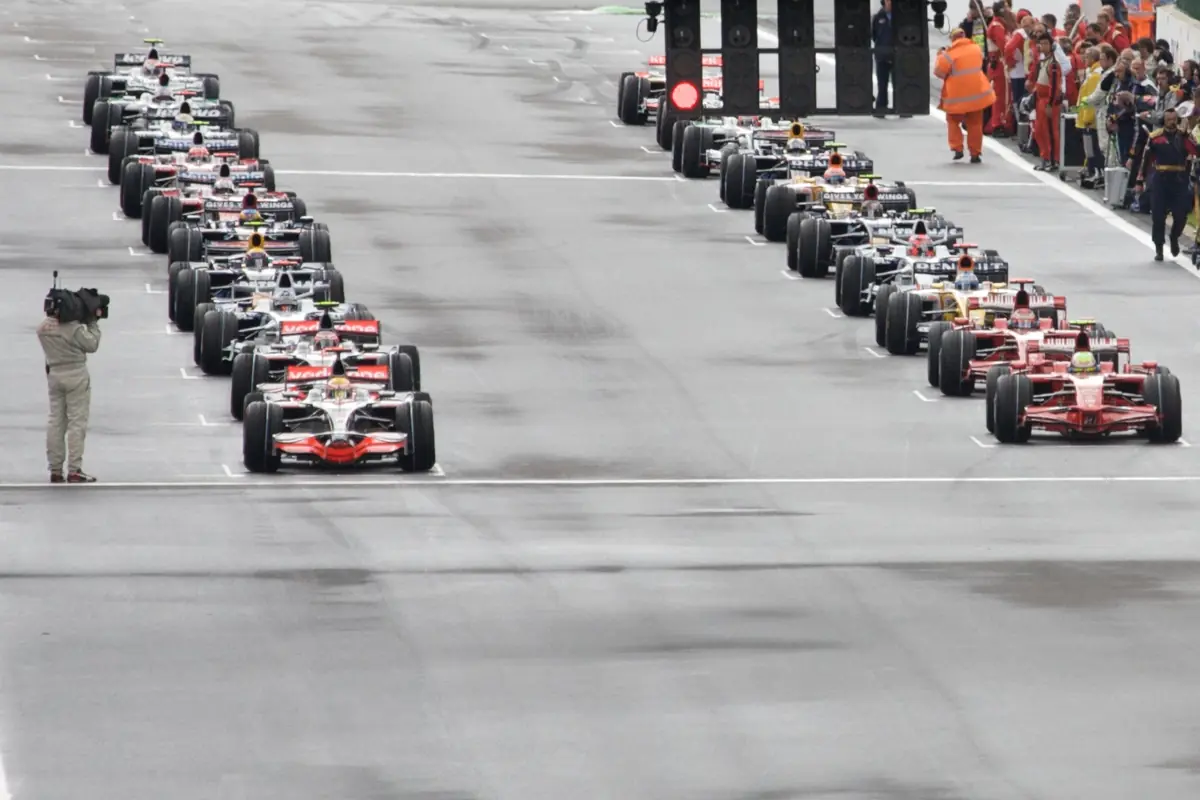
Fig. 2 Cars lined up on the grid at Spa-Francorchamps, 2008. Photo: Mark McArdle, Wikimedia Commons (opens in a new tab), CC BY-SA 2.0 (opens in a new tab), cropped to 3:2 and resized.
How do sprint points work?
Some weekends run an “Alternative Format”, the regulations’ name for a sprint weekend. A sprint takes place on the second day of track running. It is the least number of complete laps that exceeds 100 km, with a one-hour time limit.2 It has its own qualifying session and its own grid, and it scores separately from the race.
Article A2.2.2 pays the top eight in the sprint classification:1
Fig. 3 Sprint points by finishing position, 2026 Source: FIA 2026 F1 Regulations, Art. A2.2.2.1
The sprint scale is flat: each place is worth one point more than the place behind it. A sprint win is worth less than a third of a grand prix win, but a sprint pays down to 8th. The same 90% rule decides who is classified.2
On a sprint weekend, one driver can score at most 33 points: 8 for the sprint win and 25 for the race win. A team with both cars first and second in both events scores 58: 15 from the sprint and 43 from the race.1
What happens in a shortened race?
Rain, a crash or failing light can stop a race before its full distance. The 2026 rule pays points on a sliding scale, by the share of the scheduled race distance the leader completed. The scheduled distance is a number of laps, set in advance for each event.1
First, there is a floor. No points go to anyone unless the leader completes at least two complete and consecutive laps without a safety car or virtual safety car (VSC) procedure.1
Above the floor, the leader’s progress picks one of four columns:1
| Position | 2 laps to under 25% | 25% to under 50% | 50% to under 75% | 75% or more |
|---|---|---|---|---|
| 1st | 6 | 13 | 19 | 25 |
| 2nd | 4 | 10 | 14 | 18 |
| 3rd | 3 | 8 | 12 | 15 |
| 4th | 2 | 6 | 10 | 12 |
| 5th | 1 | 5 | 8 | 10 |
| 6th | – | 4 | 6 | 8 |
| 7th | – | 3 | 4 | 6 |
| 8th | – | 2 | 3 | 4 |
| 9th | – | 1 | 2 | 2 |
| 10th | – | – | 1 | 1 |
Rules as of 2026-10-18 (Section A, Issue 03). A dash means no points.
The sprint rule is simpler. The same two-lap floor applies. If the leader completes less than 50% of the scheduled sprint distance, nobody scores. At 50% or more, the full 8-to-1 scale applies.1
When a suspended race cannot restart, the result is taken at the end of the penultimate lap before the lap on which the race was suspended.2 So the result goes back two laps: the order on the lap of the red flag, and on the lap before it, does not count.
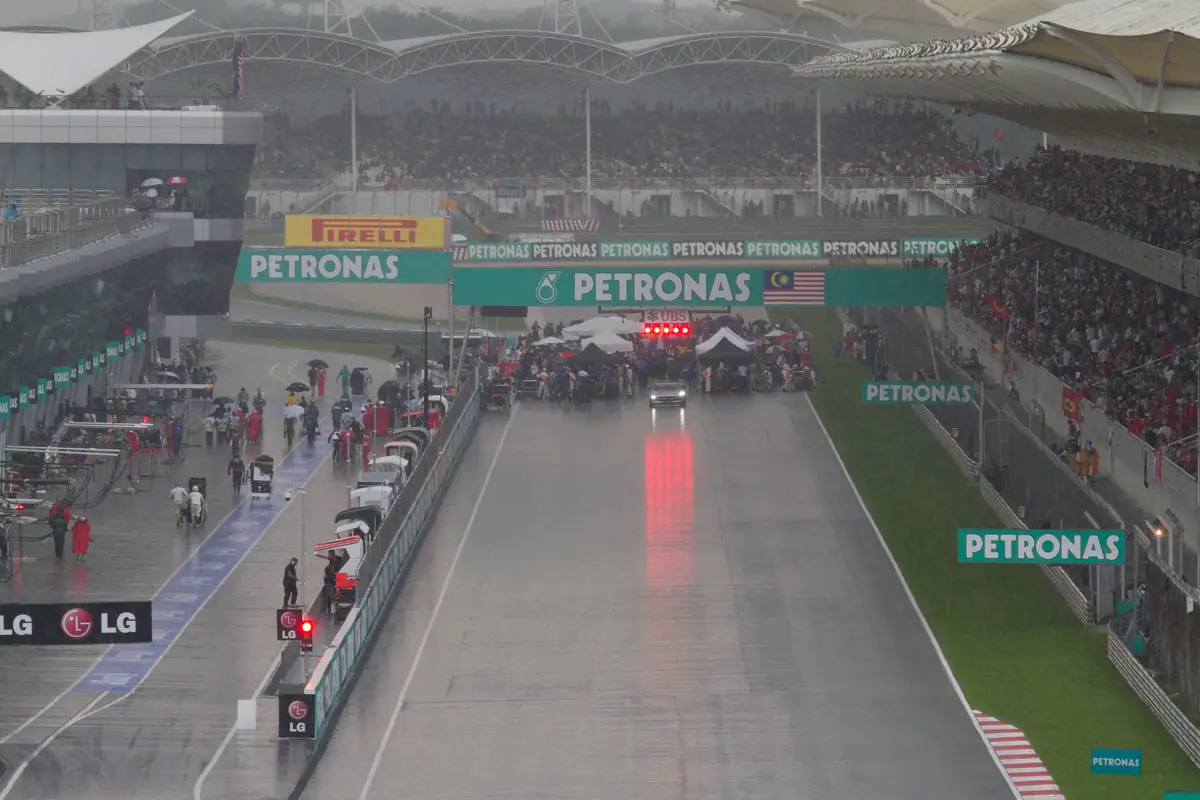
Fig. 4 A race temporarily suspended for rain: Sepang, Malaysia, 2012. Photo: Morio, Wikimedia Commons (opens in a new tab), CC BY-SA 3.0 (opens in a new tab), cropped to 3:2 and resized.
Before the sliding scale: half points
The 2018 and 2019 regulations paid half points when a suspended race could not restart and the leader had completed more than two laps but less than 75% of the distance. They paid nothing at two laps or fewer.45 A race stopped at 26% and a race stopped at 74% scored the same. The current four-column table removes that jump.
What breaks a tie in the championship?
Two drivers can end the season on the same points. Article A2.1.4 breaks the tie in this order:1
- The most wins in a race.
- If still level, the most second places in a race.
- Then the most third places, and so on down the order, until one driver is ahead.
- If that fails, the same count applied to the drivers’ qualifying results for the season.
The same rule ranks two teams on equal points. It counts places “in a race”; it does not mention sprint results.1
The fourth step is new for 2026. In 2025 the last step was different: if the count of places failed, “the FIA will nominate the winner according to such criteria as it thinks fit.”6 The 2026 rules replace that discretion with a count of qualifying results. For the format that sets those results, see our guide to F1 qualifying.
A separate rule covers a dead heat in one race, when two cars share a position. Article A2.2.3 adds together the points for the tied cars and shares them equally.1 The 2026 text does not spell out the arithmetic. The 2025 rule shared the points “for all the positions” of the tied cars, so two cars tied for first would split 25 plus 18: 21.5 points each.6
Why was the fastest-lap point removed?
From 2019 to 2024, a grand prix paid one extra point for the fastest lap. The 2019 regulations added it.5 The 2018 scale had no such point.4 Under the 2024 rule, the bonus went to the driver with the fastest valid lap, and to that driver’s team, only if the driver finished in the top 10. No point was paid if the fastest lap came from a driver outside the top 10, or if the leader completed less than 50% of the distance.7
On 17 October 2024, the FIA’s World Motor Sport Council approved changes to the 2024 and 2025 regulations, “including the removal of the point awarded for setting the fastest lap.”8 The FIA announcement gives no reason. The 2025 regulations have no fastest-lap point, and neither do the 2026 rules.61
The old rule allowed a side effect, which you can see in its text. A driver outside the top 10 could not win the point, but could take it away from a rival in the top 10 by setting a faster lap, for example after a late stop for fresh tires. Without the bonus, no driver has a points reason to chase a fast lap.
A fast lap still helps a driver finish higher, but it no longer pays a point of its own. For how fast the cars go, see our guide to F1 car speed.
What is the 107% rule?
The 107% rule is a qualifying rule, not a points rule, but it decides who gets to race for points. In the first part of qualifying, Q1, a driver is “unclassified” if their best lap is more than 107% of the fastest Q1 lap. The same test applies in the first part of sprint qualifying, SQ1.2
As a worked example, if the fastest Q1 lap is 1 minute 20.000 seconds (80.000 s), the cut-off is 85.600 s. A driver whose best Q1 lap is slower than 85.600 s is unclassified.
The same articles add three details:
- The rule does not apply when the Race Director has declared the track wet.2
- A driver who sets no lap time in Q1, or who has all their lap times deleted, is also unclassified.2
- An unclassified driver is not automatically out. The stewards decide whether that driver can start. They may consider a suitable lap time in another practice session or the driver’s earlier performance.2
A driver who does start lines up behind all the classified drivers.2 From there, they score on the same scale as everyone else.
How do the drivers’ and constructors’ championships differ?
The two titles use the same points, scored in the same races and sprints. The difference is who collects them.1
- The drivers’ title goes to the driver with the most points from every event held in the season.
- The constructors’ title goes to the team with the most points from both of its cars.
So a team’s score is the sum of the points from both of its cars. A team may use up to four drivers in races during a championship, and a new driver can score points.2 Every point a team’s cars score counts for the team, whichever driver was in the car.
Some teams use a power unit made by another manufacturer. The 2026 rules state that when such a team wins the constructors’ title, the title goes to the team, not the power unit maker.1
No points are paid for pole position, laps led or overtakes. Points are paid only for finishing positions in races and sprints.1 An overtaking aid, such as DRS before 2026 or the 2026 Overtake mode, matters only through the positions it helps a driver reach.2
What changed for 2026
The FIA reorganized the F1 rules for 2026 into lettered sections. The points rules moved from Articles 6 and 7 of the old Sporting Regulations to Article A2 of Section A.61 Compared with the 2025 rules:
- The points did not change. The grand prix scale, the sprint scale and the shortened-race columns are the same as in 2025.61
- The final tiebreak changed. Qualifying results replace the FIA’s own choice as the last step.1
- The two-lap floor changed. In 2025 it applied only when a race or sprint ended short of its scheduled distance. The 2026 text applies it “in all cases” and asks for two “complete and consecutive” laps without a safety car or VSC procedure.61
- The dead-heat wording changed. The 2026 text drops the 2025 words “for all the positions”, so it no longer says which positions’ points are pooled.61
The rules can change mid-season, so check the issue number and date on the FIA’s regulations page before you rely on a detail.3 This guide reflects Section A Issue 03 and Section B Issue 09, as of 18 October 2026.
Sources
- 1FIA, 2026 F1 Regulations, Section A: General Regulatory Provisions, Issue 03, 25 June 2026 (opens in a new tab). Accessed .
- 2FIA, 2026 F1 Regulations, Section B: Sporting, Issue 09, 1 October 2026 (opens in a new tab). Accessed .
- 3FIA, Regulations: Formula One World Championship (opens in a new tab). Accessed .
- 4FIA, 2018 Formula One Sporting Regulations, 17 July 2018 (opens in a new tab). Accessed .
- 5FIA, 2019 Formula One Sporting Regulations, 12 March 2019 (opens in a new tab). Accessed .
- 6FIA, 2025 Formula 1 Sporting Regulations, Issue 5, 30 April 2025 (opens in a new tab). Accessed .
- 7FIA, 2024 Formula 1 Sporting Regulations, Issue 7, 31 July 2024 (opens in a new tab). Accessed .
- 8FIA, Future regulations across multiple categories confirmed during the World Motor Sport Council, 17 October 2024 (opens in a new tab). Accessed .